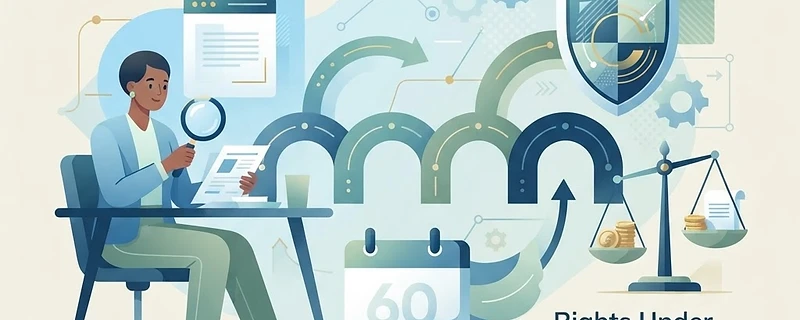
Navigating the 60-Day Dispute Timeline: Your Rights Under the FCRA
Learn how the Fair Credit Reporting Act (FCRA) regulates dispute timelines and what you can do if the credit bureaus miss their deadlines.
Receiving a credit report error can feel overwhelming, especially when you are trying to secure a loan or rent an apartment. Understanding the legal timelines governing how bureaus investigate your claims is the first step toward regaining control over your financial reputation.
The Legal Framework: How the FCRA Governs Timing
Under the Fair Credit Reporting Act (FCRA), credit reporting agencies like Equifax, Experian, and TransUnion have a specific window of time to conduct a "reasonable investigation" into your dispute. By default, the law provides bureaus with 30 calendar days to verify the accuracy of the information you are challenging.
However, this clock can be extended to 45 days in one specific circumstance: if you provide additional relevant information to the credit bureau after your initial dispute has already been submitted. The bureaus essentially use these extra 15 days to process your supplemental documentation. It is vital to keep your communication organized and date-stamped, as these windows determine when the bureau must provide you with the results of their investigation.
What Happens If the Bureaus Miss the Deadline?
If a bureau fails to complete its investigation within the 30-day window (or 45 days, if applicable), the law dictates that the disputed item must be removed from your report. While this sounds straightforward, the reality is that bureaucracy can often cause delays. If you do not receive a written response or an updated credit report within the legal timeframe, you have the right to follow up.
Start by sending a secondary letter requesting proof that the investigation was completed. Include a copy of your initial dispute submission and the date you received the return receipt. If the information remains on your report without a resolution notification, you may consider filing a formal complaint with the Consumer Financial Protection Bureau (CFPB) to compel the credit bureau to honor the FCRA requirements.
Differentiating Between Investigation and Verification
Many consumers misunderstand what constitutes an investigation. A credit bureau is not required to perform an exhaustive forensic audit of your entire financial history. Instead, they are required to verify the specific information you are challenging with the data furnisher—the original creditor or collector who provided the information to them.
If the data furnisher confirms the accuracy of the account, the bureau will generally keep the item on your report. This is why the quality of your dispute letter matters. Simply stating "this is incorrect" is rarely as effective as providing specific evidence, such as a paid-in-full letter, a canceled check, or a statement from the creditor acknowledging the error. A precise, evidence-backed dispute forces the bureau to conduct a more rigorous review rather than a simple automated verification.
Managing Your Expectations During the Process
It is important to remember that credit repair is a marathon, not a sprint. While federal law provides structure, human error and system delays occur. You might find that one item is resolved within two weeks, while another requires the full 45-day window.
Keep copies of every single document you send and every response you receive. Consistency is your greatest asset. By maintaining a clean, chronological "paper trail," you ensure that you have all the necessary evidence to advocate for your rights if a bureau fails to meet its obligations under the FCRA. Stay patient, stay organized, and always verify the updates to your reports once an investigation is finalized.
This article is general information, not legal, financial, or tax advice.
Take the next step
If you are ready to take control of your financial future, start with our free credit checkup to identify potential errors on your reports. When you are ready to start the dispute process with professional-grade tools, see Pro pricing for our full suite of automated features.
Ready to take control of your credit?
Start free, or see how Pro can speed things up.
This platform provides self-help tools and educational information. It is not a credit repair organization, credit bureau, lender, financial institution, or law firm. Use of this platform does not create an attorney-client relationship. Results are not guaranteed. Accurate negative information generally cannot lawfully be removed merely because it is unfavorable.