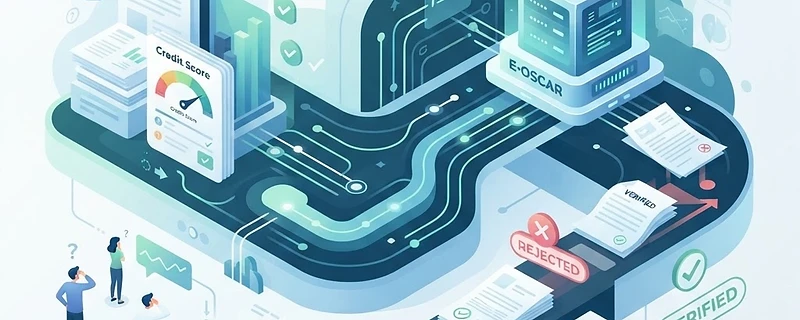
Understanding Credit Bureau E-OSCAR: Why Your Disputes Are Often Rejected
Discover how the automated E-OSCAR system processes your credit disputes and why understanding its limitations is key to effective credit repair.
When you file a dispute with a credit bureau, you might expect a person to pore over your documents and carefully investigate your claim. In reality, your dispute is likely processed through an automated system known as E-OSCAR (Online Solution for Complete and Accurate Reporting). Understanding how this system works is essential for anyone trying to navigate the credit repair process effectively. ## What is E-OSCAR? E-OSCAR is a web-based automated system that the three nationwide credit bureaus—Equifax, Experian, and TransUnion—use to communicate with data furnishers, such as banks and collection agencies. When you submit a dispute, the credit bureau does not typically conduct an in-depth manual investigation. Instead, they input your dispute into the E-OSCAR system. The system then translates your narrative into a two-digit 'Automated Consumer Dispute Verification' (ACDV) code. This code is sent to the data furnisher, who then has the opportunity to verify or correct the information. Because the system relies on these short codes, a great deal of nuance is lost in the translation. ## The Limitations of Automated Processing The primary goal of E-OSCAR is to process millions of disputes as quickly as possible. Because the system relies on standardized codes, it struggles to handle complex, fact-heavy disputes. If your dispute requires a detailed explanation or involves unique legal circumstances, it may be misinterpreted by the automated interface. Many consumers find that disputes sent via the online portal are rejected simply because they do not fit into the limited 'check-box' categories provided by the system. If your dispute is 'frivolous or irrelevant'—a term the bureaus use when they believe a dispute lacks sufficient evidence or is a repeat of a previous, resolved issue—E-OSCAR can trigger a near-instant rejection. This is why attaching specific, dated, and relevant evidence is critical; it is the only way to provide data that might actually reach a human reviewer rather than being filtered by the code-matching logic. ## How to Improve Your Dispute Strategy To increase the chances of your dispute being handled correctly, you should move beyond the simplified online dispute forms. First, provide clear, concise evidence. Instead of writing a long narrative, attach a copy of your credit report with the incorrect item circled and a copy of the documentation proving your claim, such as a canceled check, a letter from a creditor, or a police report for identity theft. Second, ensure your dispute is direct. Clearly state the exact error, the reason it is inaccurate, and what you are requesting (a deletion, an update, or a correction). Third, consider sending your disputes via certified mail with a return receipt. While this does not force the credit bureau to use a human to process your request, it creates a paper trail that demonstrates you have exercised your rights under the Fair Credit Reporting Act (FCRA). This documentation is invaluable if you ever need to escalate a dispute or prove that a bureau failed to conduct a 'reasonable investigation.' ## What Happens After Submission Once the data furnisher receives the ACDV code through E-OSCAR, they have a limited time to respond. Under the FCRA, the bureau must generally resolve your dispute within 30 days (or 45 days if you provided additional information after the initial dispute). If the data furnisher fails to respond to the bureau, the account information must be updated or deleted in accordance with your request. However, if the furnisher verifies the data as accurate through the system, the bureau will maintain the item on your report. If this happens, you have the right to request the specific method of verification used, though the bureaus often provide very limited information in response to these requests. This article is general information, not legal, financial, or tax advice. ## Take the next step Managing your credit report requires patience and a solid understanding of how the system functions. If you are ready to take control of your financial profile, you can see Pro pricing for our full suite of tools. For a quick look at where you currently stand, start with a free credit checkup at /checkup.
Ready to take control of your credit?
Start free, or see how Pro can speed things up.
This platform provides self-help tools and educational information. It is not a credit repair organization, credit bureau, lender, financial institution, or law firm. Use of this platform does not create an attorney-client relationship. Results are not guaranteed. Accurate negative information generally cannot lawfully be removed merely because it is unfavorable.